Source becomes a world
NeuralEngine
A source-to-world engine for generating interactive behavior from structured programs, with runtime evidence as the quality boundary.
The idea
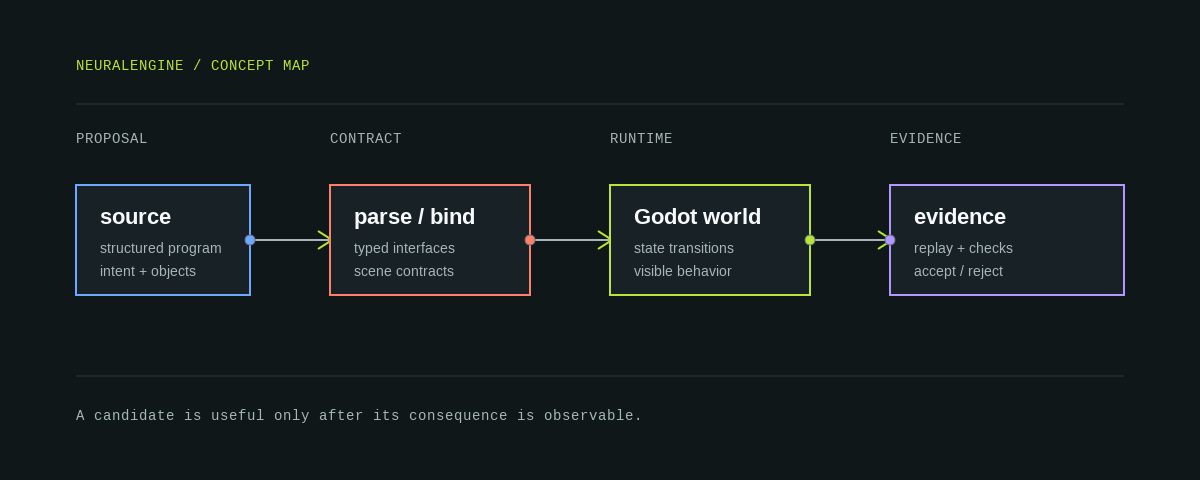
NeuralEngine treats a generated game script as a program with consequences. A model should not receive credit because its text looks plausible; the output must parse, compile, bind to the intended scene objects, and produce the expected behavior in Godot. The project is designed as a possible world-model interface: language is used to propose a transition rule, while the engine supplies the state, action, and consequence that make the proposal testable.
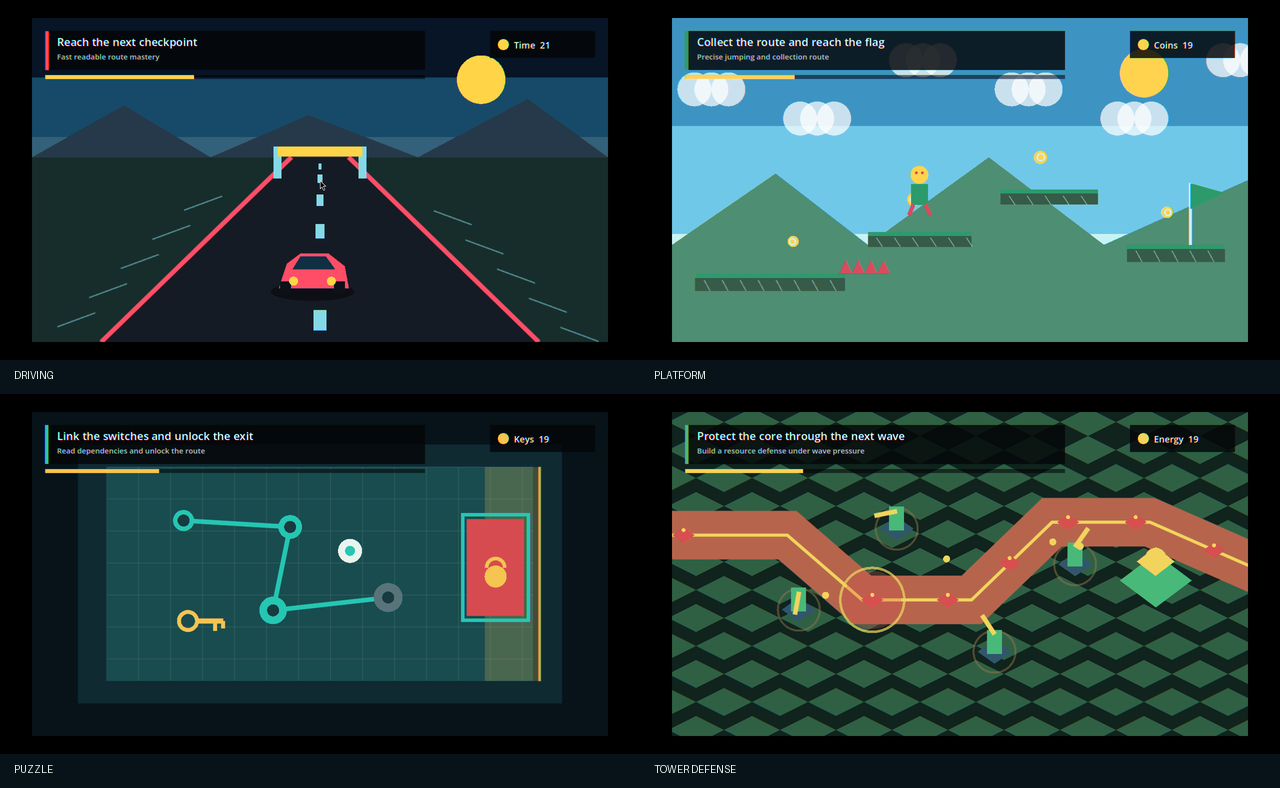
The current curriculum is built from runtime-verified source families: player movement, camera behavior, interaction, and stochastic NPC logic. Source-file groups stay intact during holdout construction so a near-duplicate script cannot quietly become a test example.
Source is treated as an executable candidate, not a prose answer.
Godot provides objects, state transitions, and visible consequences.
Every accepted behavior keeps a trace back to its source and test.
Evidence and the honest result
The source/API replay suite contains 25 training candidates across four projects and eight source-file groups. The stochastic NPC comparison matches 3,600 paired frames across three seeds, while a speed negative control changes the observed trajectory. The project has 22 Python tests and nine Godot checks passing for the data and runtime contracts.
The first real 0.5B LoRA curriculum run is a useful failure: on six project-held-out rows, raw unconstrained generation scored 0/6 for parse, compile, binding, behavior, and acceptance. This is not a finished game-generation system. It is evidence that source-to-behavior generation needs a stronger objective or decoding contract before scale is meaningful.
Why this matters
The boundary between “generated code” and “generated behavior” is where many agentic game demos become difficult to audit. NeuralEngine makes that boundary a first-class artifact. The negative result is already narrowing the design space: more epochs alone are not the next intervention; independent verified data and a curriculum or transaction-level objective are.
The longer-term research direction is to let a model propose compact mechanisms that can be composed, replayed, and tested inside a controllable world. That gives a world-model project a concrete engineering handle: the proposal is only useful when it changes the world in the intended way and remains inspectable after execution.