A body for a model
Oblivionis
An embodied research program connecting model identification, action-sensitive evidence, and active-inference ideas without overclaiming what the experiments show.
The question
Can an agent’s internal model become measurably useful for action, rather than merely accurate on a prediction task? Oblivionis approaches this from computational neuroscience and Lacanian-inspired questions about an agent’s relation to its own observations, but the experiments stay at the level of models, interventions, and control.
The project’s discipline is to separate three claims: whether a latent model can be identified, whether it improves a decision under a controlled intervention, and whether any result is specific to the proposed mechanism rather than a generic capacity advantage.
The evidence chain
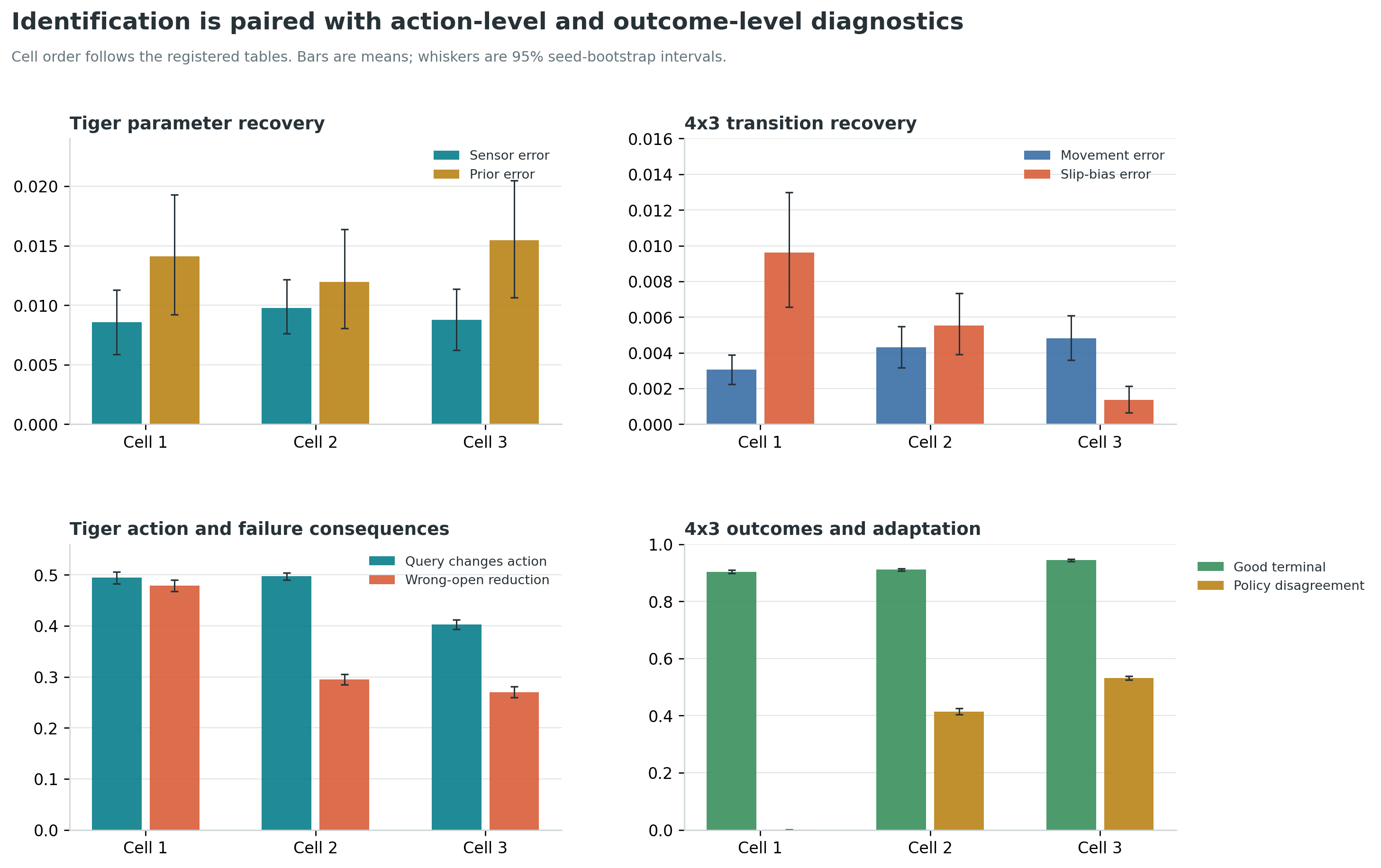
The current formal package contains 61,440 factual probes, 25,280 deployment trajectories, and 904,726 native environment steps. MiniGrid state certificates cover 72 worlds across two model interfaces. A MuJoCo history-binding study adds thousands of closed-loop trajectories and tests whether history changes prediction and control together.
The results are intentionally bounded. Correct history improves prediction in the tested setting, but control effects are sensitive to the interface and model. An Active Inference controller can improve a local mark-source action while failing the registered mirror composite and robustness gates. A reproduced public precedent does not establish a general external value beyond generic controls.
Research stance
Oblivionis does not claim consciousness, a complete Lacanian subject, general Active Inference superiority, or AGI. It asks a more tractable question: what extra experiment would distinguish a mechanism-specific explanation from a model that is simply better at the task?